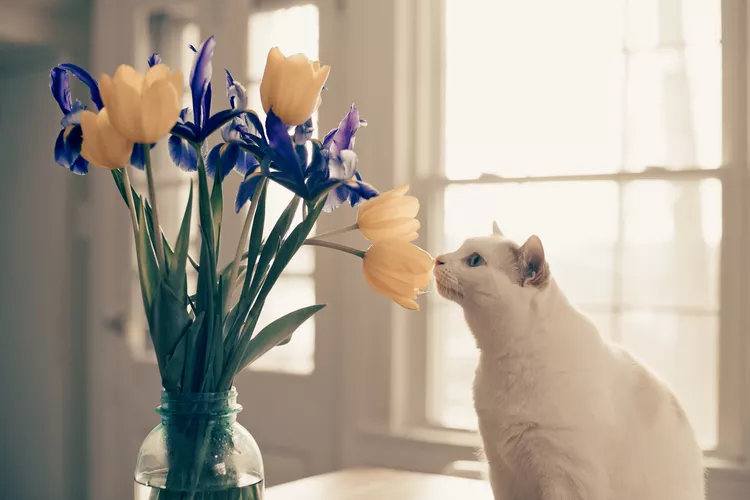
Did you know that a cat's sense of smell is about 14 times stronger than a human's? That's because the total capacity of the cat's nasal organ is comparatively larger than that of a human. It could be said that a cat's nose is its most important sensory organ.
Cats depend on their sense of smell for their very survival. A cat uses scent to sniff out food, mates, and enemies, and to identify the limits of the territories they have previously marked. The world of a cat is comprised of the world of scents and odors.
Sniffing for Food
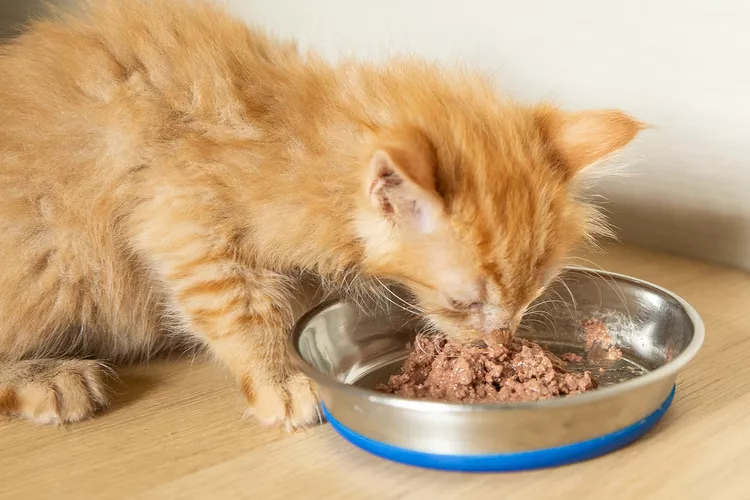
Right after birth, the blind kitten will use its sense of smell to locate its mother and to latch onto a teat. From then on, a cat's sense of smell will always lead it to food, yet sometimes in unlikely places. A cat will search high and low, in high tree branches as well as your kitchen cabinets, for the next morsel.
Because taste is so closely associated with smell, any cat with an active upper respiratory infection or even the aging cat with a reduced sense of smell may go "off" their food. You can help a cat like this by warming its food slightly to increase and enhance the odor and stimulate its appetite.
Locating a Mate
Female cats in heat (in the estrus cycle) exude a powerful sex pheromone that can be sniffed or "scented" by a male even at a distance of a mile away. If you've ever been entertained by a chorus of lusting tomcats outside your home while your unspayed female cat tries every means of escape, you'll appreciate this phenomenon. Female cats can also scent out a preferred mate by sniffing the male's territorial markings.
Establishing Territorial Lines
Male cats mark their territory with urine or with pheromones from glands in their face and feet. They will travel their territorial boundaries frequently, sniffing at their markings, and reapplying when the odor diminishes. Other male cats will smell the markings and either respect the territory or attempt to take it over by introducing their scent markings over top of the original.
Warning of Enemies and Danger
Have you ever observed a cat entering the outdoors with head held alert, whiskers twitching, and nostrils wide open? The cat in this stance is sniffing out potential harm and also collecting information about recent passers-by. If another cat has recently ventured near, or if there was fish in the delivery truck next door, the nose will tell the story with help from a powerful olfactory accessory organ.
Jacobson's Organ and the Flehman Response
Cats (along with snakes and also a few other mammals) have a magnificent organ called the vomeronasal organ, most often known as the Jacobson's organ. It is located in the nasal septum, just above the roof of the mouth, and it connects to the rest of the nasal cavity. Wrinkling and lifting its lips enables a cat to open up the ducts to the Jacobson's organ.
The appearance of the cat bringing air into the Jacobson's organ has sometimes been likened to a slightly open-mouthed "smile;" this is called the Flehmen response. The Jacobson's organ seems to play a large role in the sense of smell in all wild and domestic cats, no matter their size or species.
Feline Nose Leather
A cat's nose leather may be either black or pink, depending on genetics and the cat's basic coloring. Nose leather has a tough surface, but it is living tissue that is susceptible to disease. As with all mammals, white or light-colored cats are prone to a squamous cancer of this part of the nose and the ears.
This cancer is especially common when the cat is frequently exposed to the sun over long periods. If your cat gets a frequent sunburn to this area, there are veterinarian-approved sunscreens, compounded to be used on a cat's delicate nose and ear tips.